


Discovering the Arctic Henge in Iceland: Myth, Design and How to Visit
The Arctic Henge in Iceland sits on a windy hill in the far northeast, where the Arctic Circle meets the wide North Atlantic Ocean.
Known locally as Heimskautsgerðið, this modern stone circle made of dark volcanic rock is inspired by Viking mythology and built for the unique Arctic light.
It is not only a monument. It is a meeting point between old Norse stories, local community hopes and the changing light of the north.
If you are driving a car or campervan through North Iceland, the Arctic Henge is a quiet, reflective stop to add to your itinerary.
In summer you can see the midnight sun sliding around the horizon.
In winter you may stand among the stones with the Northern Lights above you.
Internal links: Planning a northern road trip by campervan? Compare vehicles on our
Iceland campervan and 4x4 rentals page and pair this stop with our
10 day Iceland Ring Road itinerary.
Outbound links: Before you drive to the Arctic Henge, always check conditions on
road.is and the weather at
Vedur.is.
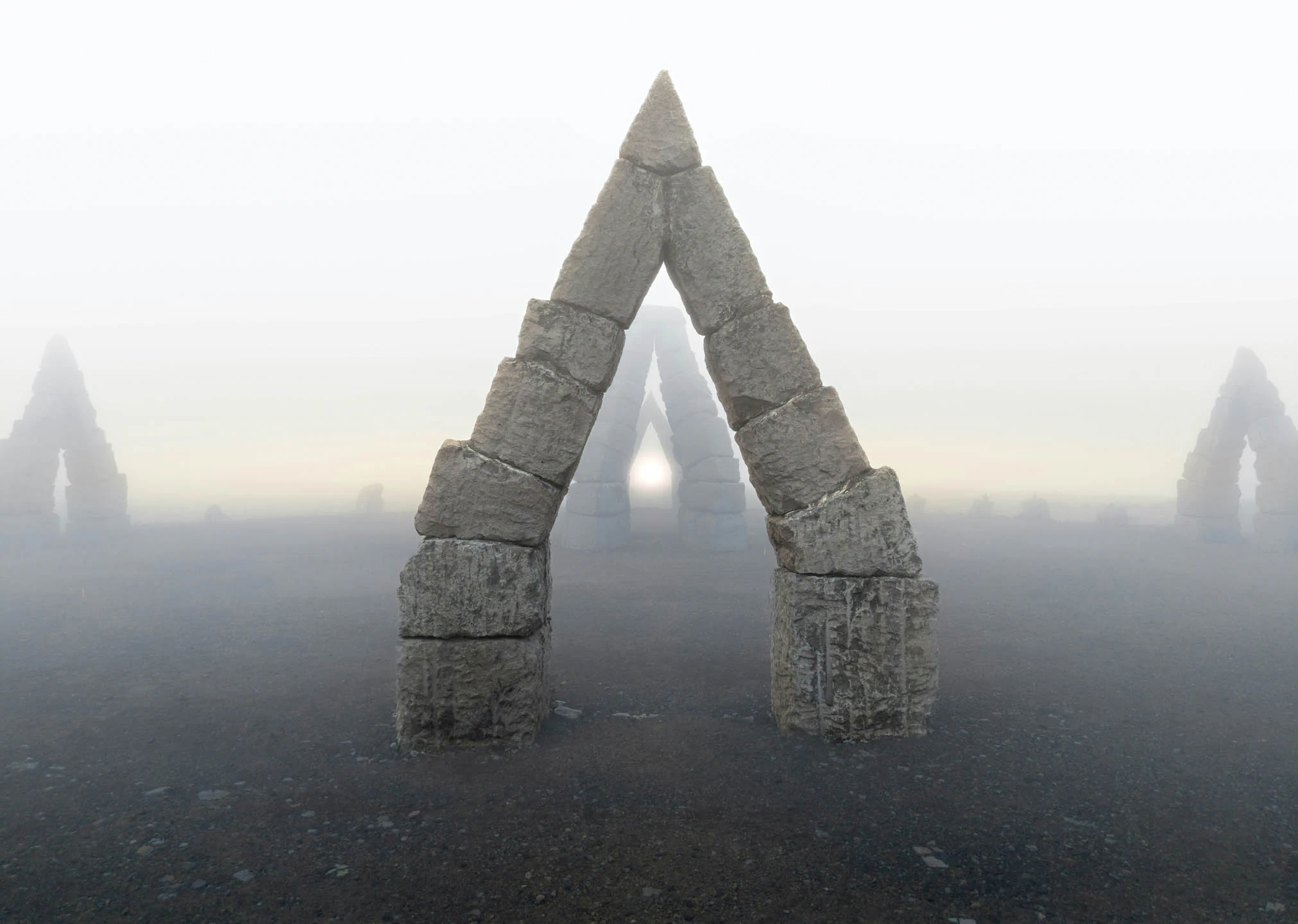
How The Arctic Henge Project Began
This early vision explains how this remote stone circle in Iceland became a cultural symbol for the north.
The story of the Arctic Henge in Iceland starts in the 1990s in the small fishing village of Raufarhöfn, one of the northernmost settlements in the country.
As fish stocks changed and jobs declined, the community needed a new way to attract visitors and keep the town alive.
Local entrepreneur Erlingur Thoroddsen had an idea.
Inspired by the ancient site of Stonehenge in England and by Icelandic sagas, he envisioned a modern stone circle in the Arctic, built from local rock and shaped by Norse myth.
In 1996 he began planning the Arctic Henge with artist Haukur Halldórsson.
Construction started in 2004 using black volcanic stone quarried from the nearby landscape, so that the structure would feel rooted in its surroundings.
The project draws heavily on the poem Völuspá from the Poetic Edda, which describes the creation of the world, the deeds of gods like Odin and the dwarves, the chaos of Ragnarök and the renewal that follows.
Erlingur wanted the Arctic Henge to do two things at once.
First, help Raufarhöfn by bringing travellers north.
Second, keep Ásatrú, the old Norse belief system, visible and meaningful in modern Iceland.
Funding challenges have slowed construction, so the Arctic Henge is still considered a work in progress.
Even so, it already attracts thousands of visitors each year and has become a symbol of both resilience and imagination for this remote corner of Iceland.
Design and Symbolism of the Arctic Henge
The Arctic Henge in Iceland was designed to align with both sunlight and Norse cosmology.
The Arctic Henge combines art, astronomy and mythology.
The circle is about 54 metres across and stands on a low hill above Raufarhöfn, with wide views of the sea and surrounding land.
The design is carefully aligned with both the sun and the stories of Norse dwarves and gods.
Main Elements Of The Arctic Henge
- Four main gates:
Four six metre high stone gates form a cross inside the circle, pointing north, south, east and west.
They mark the cardinal directions and frame the path of the sun at different times of year.
The north gate opens toward the Arctic Ocean and the summer sun that never fully sets. - Central pillar:
In the middle stands a ten metre tall stone column.
Plans include a glass top that will split sunlight into colours, echoing Bifröst, the rainbow bridge between the world of humans and the realm of the gods in Norse myth. - Seventy two dwarf stones:
Around the outer circle are 72 smaller upright stones, each dedicated to a dwarf from the sagas.
In the myths, dwarves such as Brokkr and Eitri forge powerful items like Thor’s hammer.
The stones are placed so that their shadows interact with the gates and centre at specific times, creating a kind of giant sundial. - Planned features:
The full design includes a Sun Chair for observing light, a Fire and Water space, a Star Guide aligned with the North Star and an acoustically focused Echo Spot.
Some of these elements are still under construction but they are intended to complete the symbolic cycle of creation, change and renewal.
The dark basalt stone of the Arctic Henge matches the lava fields and cliffs of northeast Iceland.
Light transforms the structure throughout the year.
On bright summer nights the sun circles low around the horizon, sliding between the gates and casting long moving shadows.
In winter the low sun and long twilight hours create strong contrasts and, on clear nights, the Northern Lights can paint the sky behind the stones.

How To Get To The Arctic Henge In Iceland
Visiting this northern stone circle gives travellers an easy chance to explore Iceland’s remote landscapes.
Part of what makes the Arctic Henge special is how remote it feels.
It lies about 10 kilometres east of the village of Raufarhöfn in North Iceland, not far south of the Arctic Circle.
Reaching it rewards you with a sense of space and quiet that is hard to find near more famous sights.
Driving To The Arctic Henge
- From Reykjavík:
The drive is around 550 kilometres and usually takes 6 to 8 hours in good conditions.
Follow Route 1 (the Ring Road) north through Akureyri and then take Route 85 northeast toward Raufarhöfn and Þórshöfn.
A short local road then leads up to the hill where the Arctic Henge stands. - From Húsavík or Ásbyrgi:
From Húsavík it is about 150 kilometres, roughly 2 hours by car.
Many travellers include the Arctic Henge as part of a loop that also visits Ásbyrgi canyon and the Tjörnes coastline. - Road conditions:
In summer, a regular 2WD vehicle is usually enough.
In winter, snow and ice are common, so a 4x4 with winter tyres is strongly recommended.
Always check road.is before you set off.
Visiting With A Campervan
For campervan travellers, the Arctic Henge works well as a calm overnight stop on a northern route.
Raufarhöfn has a simple campsite with basic facilities and electric hookups, and the stone circle is only a short drive away.
Fuel stations are limited in this region, so it is wise to refuel in Kópasker or earlier on Route 85.
Public Transport Options
Bus services to this remote region are limited and seasonal.
You can usually reach Akureyri by long distance bus and then connect to local services along the north coast, but you will still have to walk or arrange a taxi for the final stretch.
In practice, most visitors reach the Arctic Henge in their own car or rental campervan.

What To Do At The Arctic Henge
Activities here help visitors understand why the Arctic Henge in Iceland has become meaningful for culture and tourism.
There is no entrance fee and no opening hours at the Arctic Henge.
It is an open public space where you are free to wander, reflect and photograph.
Most visitors stay between 30 minutes and one hour, although photographers and those deeply interested in mythology often stay longer.
- Walk through the gates:
Enter through each of the four main arches and look at how they frame the horizon, the ocean and the village below.
On long summer evenings, watch how the sun moves in relation to each gate. - Study the dwarf stones:
Walk around the ring of smaller stones and read any information boards about the dwarves they represent.
It is a good place to sit quietly, write or simply enjoy the silence. - Take photographs:
The strong lines and open skies make the Arctic Henge a rewarding subject at sunrise, sunset and under the Northern Lights.
If you use a drone, keep a respectful distance from other visitors and be careful in strong winds. - Explore nearby:
Combine your visit with a walk to the local lighthouse, a short drive along the coast or a stop at Raufarhöfn harbour to see daily life in a small Arctic community.
Best Time To Visit The Arctic Henge
You can visit the Arctic Henge in Iceland year round, but each season offers very different light and conditions.
Choosing the right time depends on whether you care more about easy driving, midnight sun or Northern Lights.
- Summer (June to August):
Easiest driving and longest days.
Near the summer solstice the sun barely sets, so you can enjoy soft light late at night but you cannot see the Northern Lights because the sky never becomes fully dark. - Autumn (September to October):
Cooler temperatures, fewer visitors and the first chances to see auroras after dark.
Hills pick up autumn colours and sunsets can be very dramatic. - Winter (November to March):
Short days and cold, often below freezing, but excellent conditions for Northern Lights if skies are clear.
Roads can be icy or closed in storms, so always check forecasts and drive with care. - Spring (April to May):
Days grow longer, snow melts and birdlife returns.
Driving usually becomes easier again, though the ground can be wet and muddy around the site.
Practical Tips For Visiting The Arctic Henge
- These simple tips help make your visit to the Arctic Henge in Iceland comfortable and safe year-round.
- Cost and time: Entry is free. Most travellers spend 30 to 60 minutes at the site.
- Clothing: Bring a windproof jacket, sturdy shoes and gloves. The hill is exposed and can be very windy.
- Facilities: There are no toilets or shops at the Arctic Henge itself. Use facilities in Raufarhöfn before you drive up.
- Accessibility: The ground is uneven and can be muddy or snowy, so access may be challenging for wheelchairs and strollers.
- Respect: Do not climb on the stones, leave no litter and keep noise low so others can enjoy the atmosphere.
Arctic Henge FAQs
Is the Arctic Henge really free to visit?
Yes. There are no entrance fees or opening hours. You can visit at any time of day, in any season.
How long should I plan for a visit?
Most people spend around an hour walking through the gates, reading about the design and taking photographs.
If you visit around sunset or stay for Northern Lights, you may want more time.
Can I visit the Arctic Henge in winter?
Yes, but winter visits require more care.
Always check road and weather reports, use a suitable vehicle and be prepared for snow, ice and strong winds.
In return, you have a chance to see the site under stars and auroras.
Is it similar to Stonehenge?
The Arctic Henge takes inspiration from the idea of a stone circle aligned with the sky, but it is a modern Icelandic project.
It uses local volcanic rock, focuses on Norse mythology and responds to Arctic light and weather, so it has its own distinct identity.
Where can I stay nearby?
Raufarhöfn has a small hotel, guesthouses and a simple campsite that works well for campervans.
You can also stay further south along the coast and visit the Arctic Henge as a day trip.
Why You Should Add The Arctic Henge To Your Iceland Trip
Iceland is known for its glaciers, waterfalls and volcanic power, but the Arctic Henge in Iceland shows another side of the island.
It is a human made structure that still feels deeply connected to land, light and ancient stories.
Far from the busiest routes, the Arctic Henge offers a moment of stillness above the sea, with room to think about time, belief and change.
If you are already exploring North Iceland by car or campervan, taking the short detour to Raufarhöfn is a simple way to experience something unique and quietly powerful.
Park your campervan, walk up the hill and step through the stone gates.
Let the wind, the views and the stories behind the Arctic Henge turn a remote stop into one of the most memorable parts of your Iceland journey.